Key takeaways
- Cookie stuffing places third-party cookies on a user's browser without their knowledge to claim illegitimate affiliate commissions.
- According to a 2018 TrackAd study among its clients, cookie stuffing represents over 60% of fraud in advertisers' affiliate channels.
- Based on TrackAd's experience, advertisers lose between 10% and 50% of their affiliate marketing budget to cookie stuffing.
- Manual detection relies on spotting abnormal variations in traffic, bounce rate, click-through rate and conversion rate, but remains labor-intensive and incomplete.
- An effective anti-fraud solution detects affiliate platforms in the conversion path, identifies the most recent interaction and checks the cookie time.
In short
Cookie stuffing is the most common fraud in affiliate marketing: a fraudulent affiliate secretly drops tracking cookies so that orders from other channels are attributed to it and commissioned. It takes minutes to set up, is hard to detect and skews program statistics. An anti-fraud solution identifies these orders, allowing advertisers to reject illegitimate commissions and reinvest their budget.
You’ve set up an affiliate program that seems to be working. But are you sure you’re attributing commissions to the right affiliates? Affiliate marketing
fraud is common. Toolbars, brand SEA, bad deduplication, or even non-existent and already paid orders—examples abound. But the number one fraud in affiliate marketing is cookie stuffing.
Cookie stuffing is the most common fraudulent practice that e-commerce businesses face when working with affiliate platforms.
In this article, we explain everything you need to know about cookie stuffing: What is it? How do you identify it? How do you fix it? And most importantly, what benefits can you expect from an anti-fraud solution for your affiliate program?
What is cookie stuffing?
Cookie stuffing (or Cookie Dropping) is a fraudulent practice where third-party cookies are placed on a user’s browser without their knowledge or consent. It is particularly widespread in affiliate marketing and is used by fraudulent affiliates against advertisers who have already implemented affiliate programs, with the aim of attributing orders to claim illegitimate commissions. According to a study conducted by TrackAd among its clients in 2018, cookie stuffing represents over 60% of fraud in advertisers’ affiliate channels.
How does cookie stuffing work?
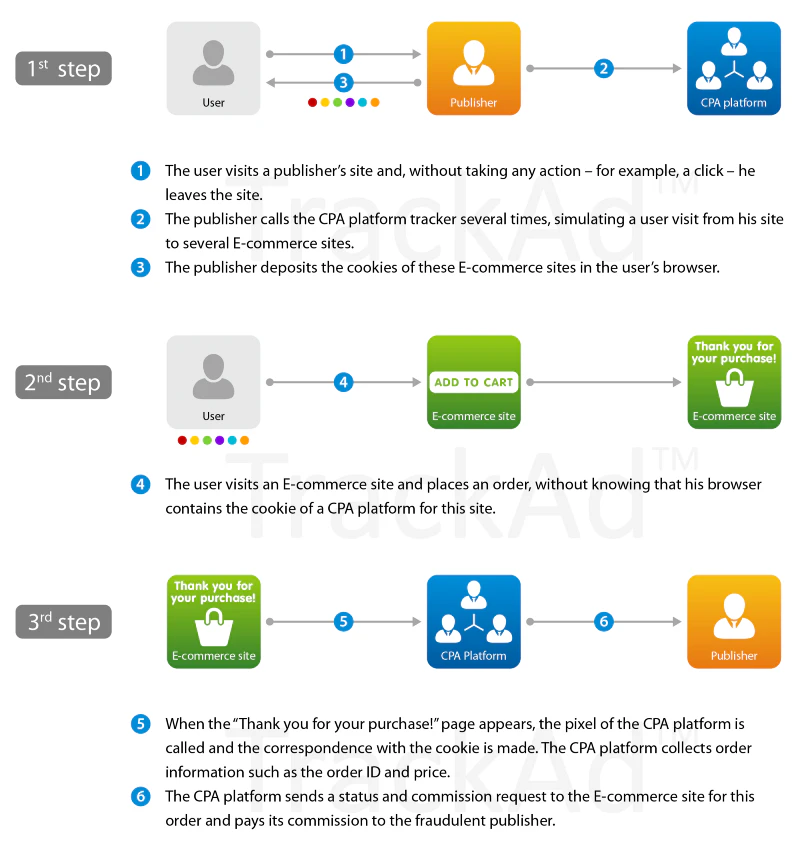
Cookie stuffing is quick to implement and operates on three principles:
- Inserting cookies without users’ knowledge
- Falsely attributing conversions (orders or leads)
- Generating fraudulent commissions.
Inserting cookies without users’ knowledge
The first step in cookie stuffing is the placement of the cookie. To do this, the fraudulent affiliate sets up malicious scripts that force the installation of tracking cookies on users’ browsers when they visit a website. Different methods can be used: JavaScript pop-ups, iFrame, Image, PHP script. Unfortunately, the user does not perceive the installation of these cookies.
Falsely attributing conversions (orders or leads)
The second step in cookie stuffing is falsely attributing conversions. When the user visits the site and completes a conversion action (either an order or a lead), the cookie attributes the conversion to the fraudulent affiliate, even though the user came from another marketing channel, whether paid or organic.
Generating fraudulent commissions
The third step in cookie stuffing is generating fraudulent commissions. Once the purchase is made and the order is falsely attributed, the order ID is sent to the affiliate platform partner, which requests status and commission from the advertiser before paying the fraudulent affiliate their commission.
Here is a scheme of the cookie stuffing process.
Why is cookie stuffing a problem?
Cookie stuffing is problematic for advertisers who have set up affiliate programs for several reasons. It’s the most widespread fraud in affiliate marketing. The technical implementation of cookie placement takes only a few minutes, and it is very difficult to detect. Affiliate program statistics are skewed, preventing advertisers from making data-driven decisions. Now that you know what cookie stuffing is and why it’s problematic, it’s time to learn how to identify and fix it.
Cookie stuffing: how to identify and fix it?
Cookie stuffing is a subtle practice that is particularly hard to spot. To identify and remedy cookie stuffing in your affiliate program, you have two options:
- use the tools you already have to try to detect cookie stuffing;
- implement an anti-fraud solution to resolve it for good.
Manually detecting cookie stuffing
To manually detect cookie stuffing, you can rely on tools you’ve already implemented and try to spot anomalies.
The best practice is to monitor your statistics and those of your affiliates and pay close attention to abnormal variations in:
- traffic
- bounce rate
- click-through rate
- conversion rate.
More concretely, you can spot cookie stuffing by comparing orders recorded by the e-commerce site with those captured by partner affiliate platforms, verifying their source, for example using an analytics solution. Be careful, though these tools only deduplicate orders based on the last click or last non-direct click. If the e-commerce site works with an affiliate platform with a post-click deduplication model, comparing orders with analytics solutions will be ineffective.
Overall, manually detecting cookie stuffing is labor-intensive and won’t guarantee the elimination of cookie stuffing from your affiliate channel.
Identifying cookie stuffing with an anti-fraud solution
The best way to identify and eliminate cookie stuffing is by implementing an anti-fraud solution. But which solution should you choose?
A good anti-fraud solution to combat cookie stuffing should:
- Detect the presence of the affiliate platform in the conversion path
- Identify which interaction is the most recent if multiple affiliate platforms are present in the same conversion path
- Ensure that the winning click occurred within the pre-order period set with the affiliate platform (cookie time)
Furthermore, it’s recommended to have a detailed analysis of each affiliate’s traffic quality, an automatic arbitration tool, and a solution to block fraudulent affiliates.
Based on TrackAd’s experience with many large e-commerce sites, advertisers lose between 10% and 50% of their marketing budget spent on the Affiliate channel due to cookie stuffing.
It’s a good reason to address the issues of cookie stuffing, isn’t it? But what are the exact benefits?
Fixing cookie stuffing: what benefits can you expect?
Resolving cookie stuffing issues is essential for having an optimized and sustainable Affiliate channel. But what exactly are the benefits?
Here are 5 benefits of an affiliate program without cookie stuffing:
An optimized Affiliate budget
The first benefit of addressing cookie stuffing is optimizing the budget dedicated to the affiliate channel. Identifying cases of cookie stuffing allows you to save money on fraudulent orders and reinvest in campaigns and marketing channels that generate the best results. The outcome? Less wasted budget and more successful orders!
Better order authentication
Resolving cookie stuffing issues enables accurate authentication of orders within affiliate programs. Genuine and fraudulent orders are clearly identified, providing you with all the necessary data to reject commissions claimed by fraudulent affiliates.
Improved customer knowledge
Using anti-fraud tools to combat cookie stuffing provides more accurate conversion data. This means gaining a better understanding of the actual customer journey and identifying the most influential touchpoints in the customer’s decision-making process. These valuable insights help you personalize your affiliate strategies and enhance the customer experience!
A high-quality affiliate base
Fighting against cookie stuffing helps you build a high-quality affiliate base. It allows you to better track each affiliate’s performance, reward those who drive authentic orders, and ban fraudulent affiliates. More broadly, it helps you create a fair environment for your affiliates and fosters stronger relationships with them.
A sustainable affiliate channel
On a broader scale, eliminating cookie stuffing optimizes and ensures the sustainability of an affiliate program. By making data-driven decisions, you have everything you need to implement effective marketing strategies, manage your budgets, and choose your partners wisely and effectively.
Conclusion
Now you know what cookie stuffing is, how it works, and most importantly, why and how to get rid of it! If you suspect cookie stuffing in your affiliate programs, implement best practices and the right tools to remedy it quickly. Your channel, budget, and reputation will all benefit! To learn more, discover the anti-fraud solution that saves our clients 23% of their affiliate budget!
Cookie stuffing in 6 questions
What is cookie stuffing in affiliate marketing?
Cookie stuffing, also called cookie dropping, is a fraudulent practice where third-party cookies are placed on a user's browser without their knowledge or consent. Fraudulent affiliates use it against advertisers running affiliate programs to have orders attributed to them and claim illegitimate commissions.
How are stuffed cookies installed on a user's browser?
The fraudulent affiliate sets up malicious scripts that force the installation of tracking cookies when users visit a website. Methods include JavaScript pop-ups, iFrames, images and PHP scripts, and the user does not notice the installation.
How does cookie stuffing generate fraudulent commissions?
When the user later places an order or submits a lead, the cookie attributes the conversion to the fraudulent affiliate, even if the user came from another paid or organic channel. The order ID is then sent to the affiliate platform, which requests the commission from the advertiser and pays the affiliate.
Why is cookie stuffing hard to detect?
The cookie placement takes only a few minutes to implement and is invisible to users. It skews affiliate program statistics, which prevents advertisers from making data-driven decisions.
Can analytics tools reveal cookie stuffing?
You can compare orders recorded by the e-commerce site with those captured by affiliate platforms and verify their source with an analytics solution. However, these tools deduplicate on the last click or last non-direct click, so the comparison is ineffective when the affiliate platform uses a post-click deduplication model.
What are the benefits of eliminating cookie stuffing?
Advertisers optimize their affiliate budget, authenticate orders and gain more accurate conversion data about the customer journey. It also helps build a high-quality affiliate base by rewarding those who drive authentic orders and banning fraudulent ones, making the channel sustainable.